
Google Is Reshaping Search Around AI Mode, and Website Owners May Need to Work Harder for Traffic
Google Search is moving past the familiar rhythm of typing a few words, scanning blue links, and opening tabs until something useful appears.
The company’s latest Search update points to something more active. Google wants Search to handle longer questions, keep track of context, watch for changing information, build custom tools, and help users complete tasks. That is a very different job than showing a list of pages.
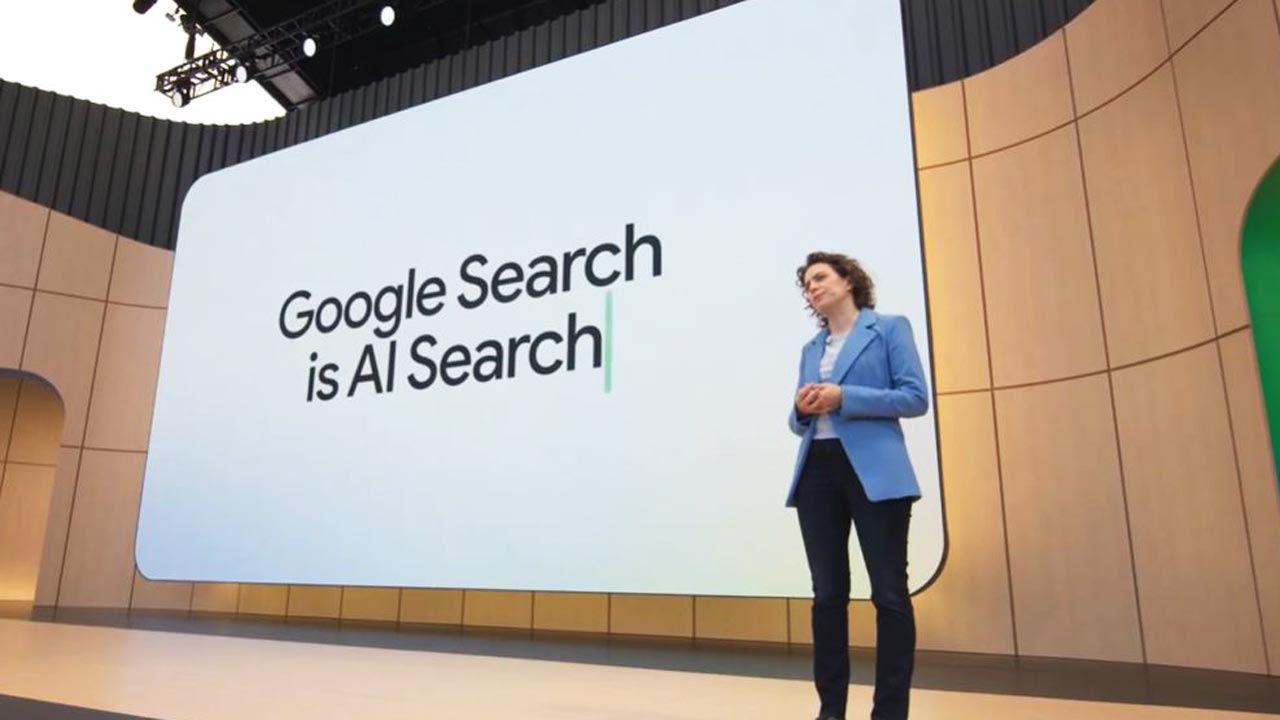
Google announced the changes at I/O 2026 on May 19. The company described them as the “next chapter” for Search and the largest upgrade to the Search box in more than 25 years. Elizabeth Reid, Google’s vice president of Search, said the company is bringing more advanced model capabilities into Search, including agents that can work from a user’s question.
For everyday users, the pitch is simple enough. Ask bigger questions. Use more than text. Keep the conversation going. Let Google do more of the legwork.
For website owners, publishers, SEO teams, and local businesses, the shift is less tidy. If Search does more before a user clicks through to a website, the old bargain between Google and the open web gets a little more complicated.
(Below) Google I/O 2026 keynote speaker Elizabeth Reid addresses the coming changes to Google Search.
Google AI Mode to Become the Centerpiece of Search
The most visible piece of the update is AI Mode, which Google says now has more than 1 billion monthly users. Google also said AI Mode queries have more than doubled every quarter, showing how quickly users are changing the way they search.
Google is upgrading AI Mode with Gemini 3.5 Flash as the default model globally. That may sound like inside-baseball tech naming, but the practical meaning is easier to grasp. Google is putting a faster, more capable AI system into the middle of Search, not off to the side as an experiment. The difference is speed and usefulness. A stronger model can handle longer questions, weigh more context, and keep a task moving without forcing users back into a pile of separate searches.
What is Gemini 3.5 Flash?
Gemini 3.5 Flash is part of Google’s newest Gemini model family. In plain English, it is the AI system doing more of the reasoning and task-handling inside AI Mode. Google says it is built for speed, coding, multimodal understanding, and longer agent-style work, which means it can help Search respond to more complex questions and follow multi-step requests without moving as slowly as larger models.
The Search box itself is changing too. Google says the new AI-powered box can expand as users type, suggest better versions of their questions, and accept text, images, files, videos, and Chrome tabs as inputs. A user might start with a screenshot, add a few lines of context, and ask for a plan, comparison, or next step.
The difference from today’s AI Mode is scope. Google is broadening the experience from a smarter answer box into a larger search workspace, one that can take more input types, carry context into follow-up questions, and connect a user’s request to deeper tasks. For websites, that means pages are being judged against fuller user situations, not just traditional keyword searches.
Longer Questions Replace Keyword Fragments
For years, search strategy often started with the phrase people typed. “Best dentist near me.” “Roof repair Wilmington NC.” “How to fix slow website.”
Those searches are not disappearing. They are being joined by longer, more specific questions with more intent tucked inside them.
A user may not ask for “roof repair” anymore. They may ask for help comparing roof repair options after a storm, checking warranty language, understanding insurance timing, and finding a company that can come out before the weekend. That is not a keyword. It is a situation.
Google’s update is built for those situations. The company says users will be able to ask follow-up questions from an AI Overview and move into a conversational back-and-forth with AI Mode, while Search keeps context and updates the supporting links.
That shift could have a large ripple. A website that answers only the shallow version of a question may get skipped over by an AI system trying to satisfy the deeper one.
Search Agents Bring Monitoring into the Background
The most consequential part of Google’s announcement may be Search agents.
Google says its first agents will be information agents that can run in the background, monitor the web, track fresh data, and send synthesized updates when something matches a user’s request. The company gave examples such as apartment hunting with very specific requirements or tracking a product drop from a favorite athlete. These information agents are expected to launch first for Google AI Pro and Ultra subscribers this summer.
That turns Search from a one-time activity into an ongoing watchtower. Users do not have to come back and search again. They can ask Google to keep looking.
That may be useful for users. It also marks a major shift in how discovery works. If Google decides which updates are worth surfacing, websites need to make their information easy to understand, easy to verify, and current enough to be trusted by people and machines.
A stale service page, vague product description, or thin blog post will have a harder time competing in that environment. Not because Google said so in those words, but because the task has changed.
For publishers, that shift could be especially sharp. If Search agents monitor stories, summarize updates, and decide which links support the answer, publishers may have fewer chances to earn a visit even when their reporting helps feed the result.
(Below) Google's promotional video provides a glimpse of what the new Search user interface will look like. Read more about the coming changes.
Booking, Calling, and Shopping Move Closer to the Result
The update also expands agentic booking in Search. Users will be able to give specific criteria, such as finding a private karaoke room for six on a Friday night that serves food late, and Search will pull together pricing, availability, and links to finish booking through a provider. For selected categories such as home repair, beauty, and pet care, Google says users can ask Search to call businesses on their behalf. Those capabilities are planned for everyone in the United States this summer.
That is where the update moves from information into action.
For local businesses, this creates a sharper test. Basic information needs to be correct across the web. Hours, services, appointment rules, pricing signals, availability, photos, reviews, and booking paths all become part of the customer journey before a person ever lands on the website.
A beautiful homepage will not help much if Google cannot figure out whether the business offers the service, serves the location, has current availability, or looks credible enough to include in the next step.
Generative UI and Mini Apps Change the Shape of Answers
The update also brings Search into a more visual and interactive format. With generative UI, Search can create custom layouts, tables, graphs, simulations, and visual tools based on the question. The company says these capabilities will be available in Search this summer at no charge.
It does not stop there. Google says Search will eventually be able to build mini apps, such as custom dashboards, trackers, or planning tools that users return to over time. The company tied this to Antigravity and said these custom experiences will come first to Google AI Pro and Ultra subscribers in the United States.
What is Google Antigravity?
Antigravity is Google’s AI coding and app-building environment. In Search, Google is positioning it as the system that can help generate small, custom tools from a user’s request, such as a fitness tracker, planning dashboard, or other mini app tied to live information. The practical shift is simple. Search would not just find a tool. It could help create one.
Search has long sent people to tools. Now Google wants Search to make the tool.
For publishers and website owners, this raises a practical question. If Google can assemble the comparison table, calculator, tracker, or explainer inside Search, which pages earn the click?
Personal Intelligence Makes Search More Contextual
Personal Intelligence is expanding in AI Mode. Users can connect apps such as Gmail and Google Photos, with Calendar support coming later. Google says users choose if and when to connect those apps.
This adds another layer to Search. The answer may no longer depend only on the public web. It may also depend on a user’s private context.
For users, that could be useful. Search might help plan around emails, photos, dates, reservations, or reminders. For businesses trying to be found, it means the same query may lead to more personalized outcomes.
The unanswered question is how much personal and business information users should hand over to make that convenience work. For individuals, that means thinking carefully before connecting email, photos, calendars, location history, and other private context. For businesses, the stakes are higher. Few companies want confidential plans, client information, internal documents, or sales data flowing into a large platform built around data-driven advertising and market intelligence.
Website Owners Need Clearer Pages, Not Louder Ones
The response to this update should not be panic. It should be cleanup.
Website owners should audit their most important pages for clarity, specificity, trust signals, and usefulness. Start with service pages, product pages, location pages, pricing pages, comparison content, and other high-traffic pages.
A good page should answer the real question behind the search. It should explain who the service is for, where it applies, how the process works, what the next step looks like, and how a reader can verify the claim. It should use plain language and avoid filler. It should make the business or publisher easy to trust.
Website owners should also be asking a harder question about Google’s version of the future. If Search answers more questions, books appointments, monitors updates, and builds tools inside Google, referral traffic from Search could be headed for an even steeper drop.
And if fewer users leave Google to visit the open web, how much of that web actually remains visible?
For now, the safest move is not to chase every AI feature. Fix the pages people already depend on. Make them clearer. Make them more complete. Make them easier to verify.
Search is getting better at understanding complicated requests. Websites need to get better at answering them.




0 Comments